When a donor loses faith in where their money went, it is tempting to reach for a better report. A cleaner dashboard, a more detailed acquittal, a PDF with more rows. But the report is almost never the thing that was missing. By the time a donor is asking for proof, the trust has already leaked away, quietly, in the gaps the journey left open weeks earlier. Proof of delivery is not something you produce at the end. It is something you design into the middle.
Giving journeys carry a double burden of trust that most products never have to hold. A donor gives on faith that the money will reach someone who genuinely needs it. A recipient waits on faith that the help is really coming. Break either side and the whole system loses credibility, and the two sides rarely see each other, so each is trusting a process neither can watch.
The trail is where it breaks. Money passes from a donor to an organisation, to a field team, to an agent, to a recipient. Every handoff is a point where the story can go dark. No confirmation that the money moved. No receipt at the far end. No way, later, to show that the right person received the right amount at the right time. Each of those gaps is invisible while things are going well. They only surface when someone asks a question the system cannot answer, and by then it is too late to answer it honestly.
This is why proof of delivery is a design problem. The instinct is to treat it as reporting: gather what happened, assemble it afterwards, present it on request. But you cannot report on a moment you did not capture. If the agent who handed over the cash confirmed nothing, if the recipient acknowledged nothing, if the handoff between the field team and the wallet left no trace, there is no record to assemble later, only reconstruction and hope. The proof has to be built as the money moves, not written up once it has stopped.
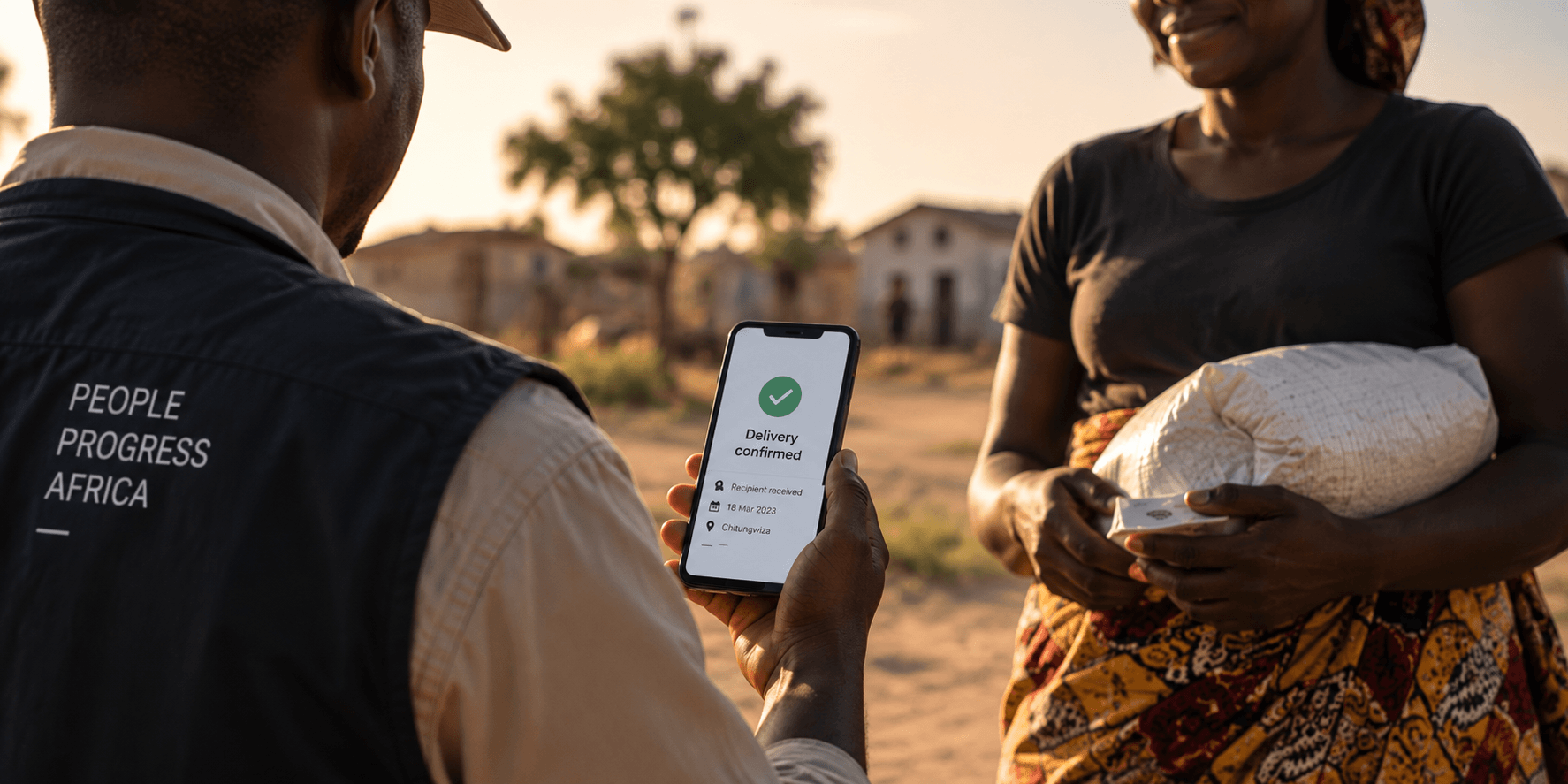
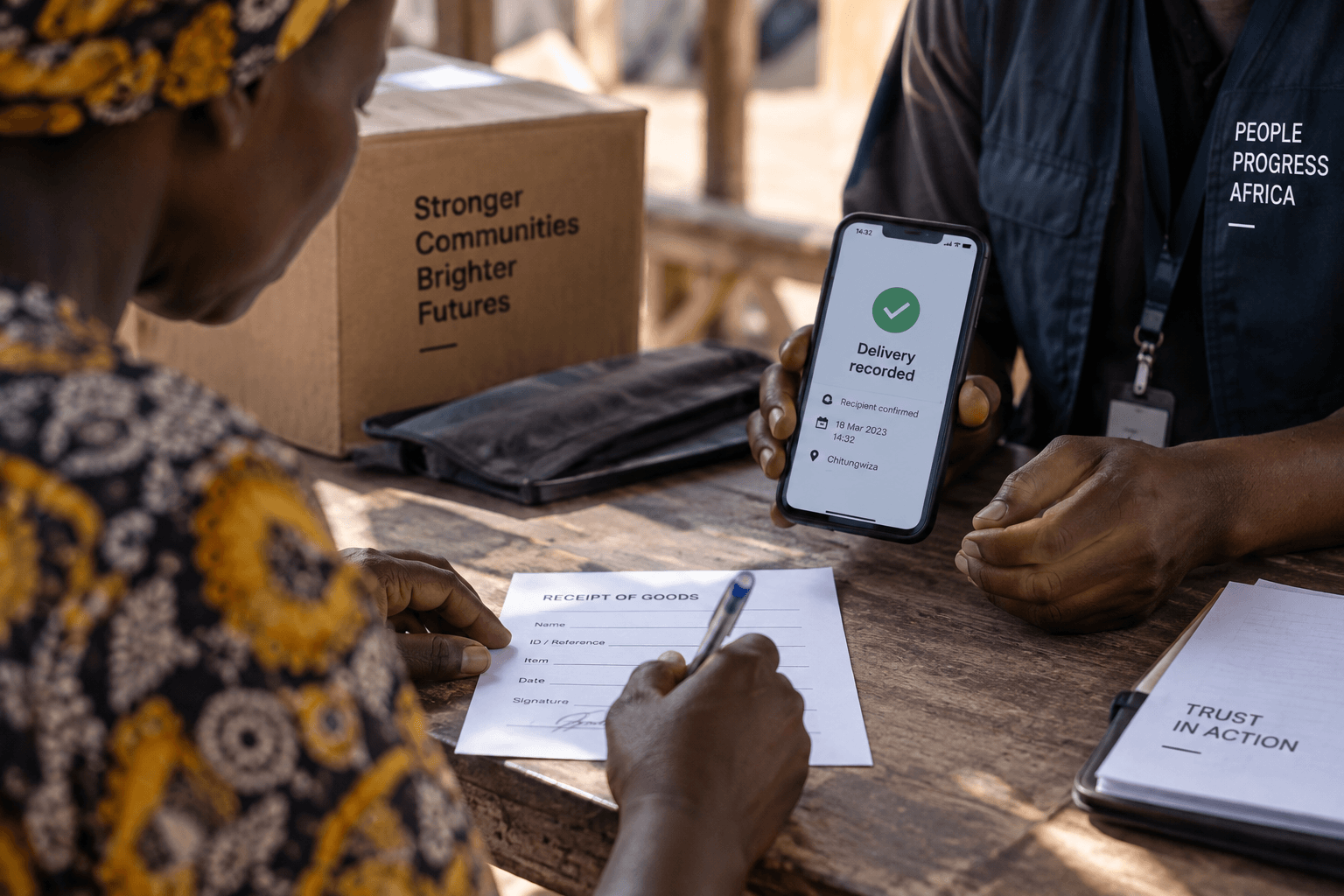
Designing for it changes what you build at every step. It means the donor’s confirmation is not just a thank-you but the first link in a chain: what was given, when, and where it entered the system. It means each handoff produces its own small, verifiable record, so the trail is continuous rather than a series of disconnected claims. And it means the moment of delivery, the point where a real person actually receives help, is captured in a way that respects them: a confirmation that works on a basic phone, in a local language, offline if it must, rather than a step that assumes a smartphone and a data connection the recipient may not have.
Build the proof as the money moves
That last point is where good intentions most often exclude the very people the money was meant to reach. Recipients are frequently the least-served users in the entire chain: unreliable connectivity, shared or basic devices, low literacy in the interface language. A proof-of-delivery step that demands a smartphone app and a stable connection does not just fail technically. It quietly redraws the line of who can be helped, and it draws it around exactly the people who needed helping most. Dignity and evidence are not in tension here. The same design that treats the recipient as a real person with real constraints is the design that produces trustworthy proof.
Get this right and the report writes itself, because the record already exists. The donor can see that help reached a real person. Every handoff left a visible, checkable trail. The recipient reached their money without indignity, and the confirmation of that is not a burden bolted onto them but a natural part of a journey built around what they actually have. The acquittal at the end is no longer an anxious act of reconstruction. It is a printout of something that was true all along.
If your organisation moves money on behalf of donors, do not start by asking what report you need to produce. Start by asking where, in the journey the money already takes, the trail currently goes quiet. That silence is the design problem. The report is only ever as good as the moments you remembered to capture.
You cannot report on a moment you did not capture. The proof has to be built as the money moves, not written up once it has stopped.
AfriUX designs and builds complex digital systems for African markets, with a focus on the moments where trust is won, lost or repaired. If giving and disbursement is one of your high-stakes journeys, a Trust Audit is a good place to start.