
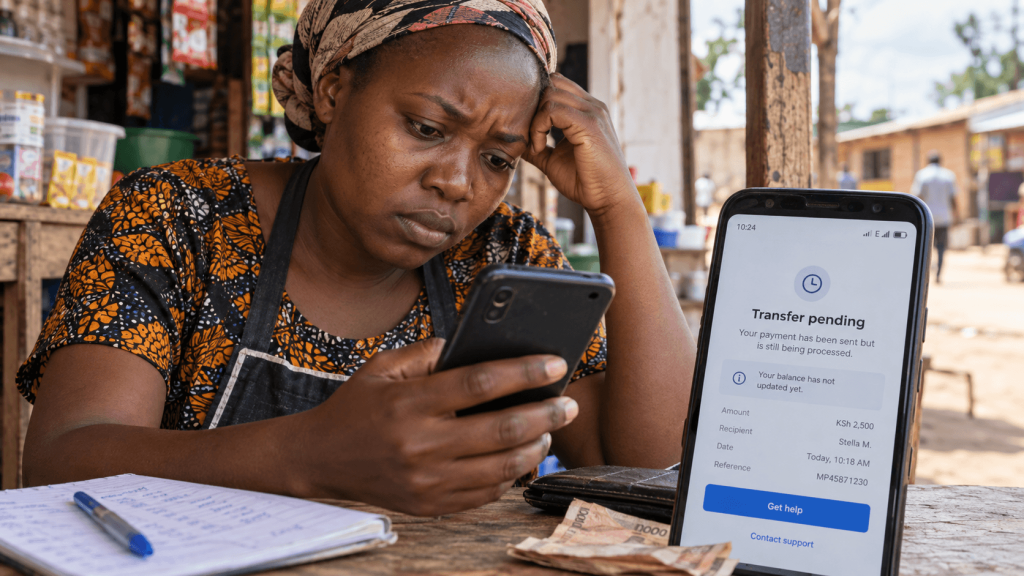
Money movement is the journey where trust is won or lost fastest: sending, receiving, and recovering when something goes wrong. A transfer that stalls, a balance that looks wrong, a payment that fails without explanation. These are the moments people remember, and the moments that decide whether they come back.
Where money movement breaks
Trust in money movement rarely breaks at the moment of payment. It breaks in the silence around it: the transfer that shows no status, the balance that updates late, the failure message that explains nothing.
In African markets the pressure is sharper. Payments cross networks, agents, wallets and banks. Connectivity drops mid-transaction. A single failed transfer can represent a meaningful share of someone’s money, so the stakes of getting recovery right are high.
So the hard part is not the happy path. It is the pending state, the retry, the reversal and the moment someone needs to reach a human and be understood.
How
AfriUX approaches it
We start by walking the whole journey the way a real user would, on a real device, including the paths teams prefer not to look at: the failed transfer, the timeout, the disputed amount. We map where a person is left uncertain and what they are likely to do next.
Status and clarity – We design every transaction to answer three questions at all times: what is happening, is my money safe, and what do I do next. Pending, delayed, failed and reversed each get honest, specific treatment.
Recovery and handoff – When something goes wrong, we design the path back: a clear way to retry, to see where the money is, and to reach a human without starting over. Recovery is treated as part of the product, not an afterthought.

What good looks like
- People always know the state of their money
- Failures explain themselves and offer a clear next step
- Recovery never forces someone to start over
- A human is always reachable, with context intact
- The journey works on low-end devices and unreliable connections